

Legionnaires' Disease Outbreaks
What counts as an outbreak
An outbreak occurs when two or more people are exposed to Legionella in the same place at about the same time and become ill. Most reported cases are never linked to an outbreak at all.
Why most cases are never traced
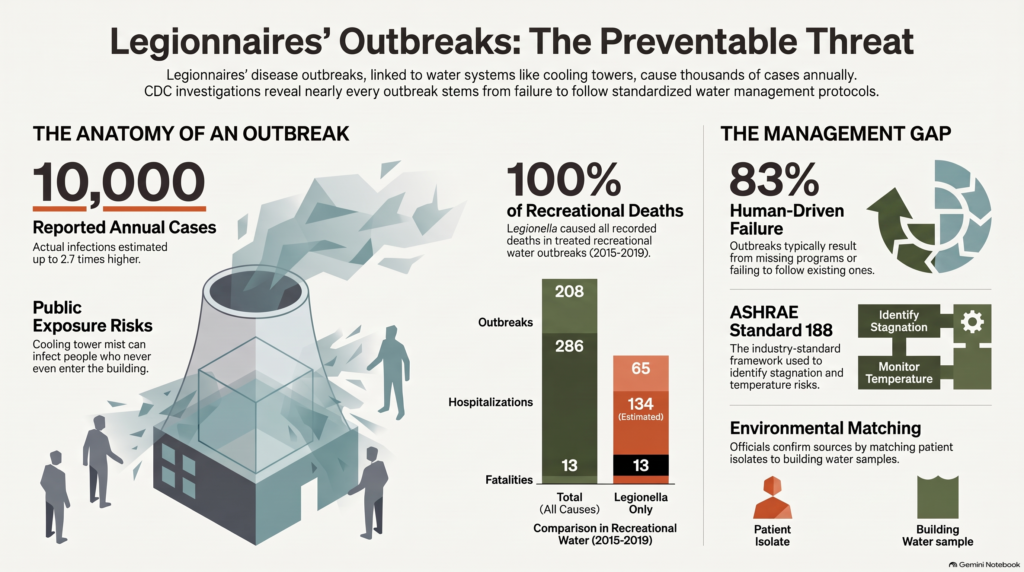
Around 10,000 cases of Legionnaires’ disease are reported in the United States each year, and the great majority are recorded as isolated infections with no identified source.
That reported figure is itself a floor. CDC cites an estimate that the true number of cases may be 1.8 to 2.7 times higher, because the illness is only identified when a clinician orders a specific test.
Source: Emerging Infectious Diseases 31(1), 2025 — https://wwwnc.cdc.gov/eid/article/31/1/24-0916_article
That is not because those infections came from nowhere. Every case came from a water system somewhere. It is because a single case rarely triggers an investigation, and by the time anyone might look, the patient has been discharged, the sample was never cultured, and the building has no reason to test.
Outbreaks get investigated. Individual cases mostly do not. The difference is not the severity of the illness — it is whether a pattern was visible from the outside.
How an outbreak is investigated
- A case is confirmed by laboratory test. Legionnaires’ disease is a notifiable condition, so the clinician reports it to the local health department.
- The patient is interviewed about where they have been in the two weeks before falling ill — hotels, hospitals, workplaces, spa facilities.
- Health officials look for overlap between that history and other recent cases. Two people who stayed at the same hotel a week apart is the pattern that starts an investigation.
- The suspect building’s water systems are sampled — cooling towers, hot water systems, spa pools, fountains.
- Environmental isolates are compared against the patient’s own isolate. A match confirms the source.
Recreational water
CDC examined outbreaks associated with treated recreational water — pools, hot tubs and water playgrounds — reported between 2015 and 2019. There were 208 of them across 36 states, causing at least 3,646 illnesses, 286 hospitalisations and 13 deaths.
Among the 155 outbreaks with a confirmed cause, Cryptosporidium caused more outbreaks than Legionella — 76 against 65.
Every one of the 13 deaths occurred in a Legionnaires’ disease outbreak.
A third of the outbreaks were associated with a hotel, motel or resort, and half began between June and August.
Source: Hlavsa MC, et al. Outbreaks Associated with Treated Recreational Water — United States, 2015–2019. MMWR 70(20), 2021 — https://doi.org/10.15585/mmwr.mm7020a1 · reviewed September 2026
Cooling towers
Cooling towers sit on the roofs of offices, hospitals, factories and data centres, shedding heat by evaporating water. When Legionella establishes itself in one, the mist carries it outward — sometimes for considerable distances, over streets and into the air intakes of neighbouring buildings.
New York City’s experience illustrates the scale. Research published in Emerging Infectious Diseases documented six community-associated outbreaks in the city from 2006 onward, causing 213 cases and 18 deaths. Three occurred in 2015 alone, including the largest recorded in the city at 138 cases. Only three of the six were linked to a cooling tower by molecular comparison of patient and environmental isolates. The sources of the other three were never determined — large investigations by one of the best-resourced city health departments in the country, and half of them ended without an answer.
What makes cooling towers distinctive is that exposure requires no relationship with the building at all. People who never entered it, never worked there and never knew it existed have been infected walking past.
Source: Fitzhenry R, Weiss D, Cimini D, et al. Legionnaires’ Disease Outbreaks and Cooling Towers, New York City. Emerging Infectious Diseases 23(11), 2017 — https://doi.org/10.3201/eid2311.161584 · reviewed September 2026
What outbreak investigations keep finding
When CDC reviewed the outbreaks it investigated between 2015 and 2019, it reached a conclusion that ought to be better known: every deficiency behind those outbreaks could have been prevented by a comprehensive, properly implemented water management programme.
The two most common problems were not technical failures. In 43% of cases the building simply had no water management programme. In another 40%, it had one that would have worked — and did not follow it.
Source: CDC, Key Findings: Outbreaks and Water Management Gaps — https://www.cdc.gov/control-legionella/php/data-research/outbreaks-water-management-gaps/index.html · reviewed September 2026
What prevents them
A water management programme identifies where in a building water can stagnate or sit at temperatures where Legionella multiplies, sets limits for temperature and disinfectant, requires that someone verify them on a schedule, and defines what happens when a reading is wrong.
The framework is published in ASHRAE Standard 188 and in CDC’s toolkit for building owners. Healthcare facilities participating in Medicare and Medicaid are already required to have one. For most other buildings in most states, it remains voluntary.
Know when an outbreak is reported near you
We send occasional alerts on outbreaks, legislation and new research. No more than that.
Additional Sources
Sources
CDC, Key Findings: Outbreaks and Water Management Gaps — the 43% and 40% findings
https://www.cdc.gov/control-legionella/php/data-research/outbreaks-water-management-gaps/index.html — free
Hlavsa MC, Aluko SK, Miller AD, Person J, Gerdes ME, Lee S, Laco JP, Hannapel EJ, Hill VR. Outbreaks Associated with Treated Recreational Water — United States, 2015–2019. MMWR 70(20), 21 May 2021: 733–738
https://doi.org/10.15585/mmwr.mm7020a1 — free
Fitzhenry R, Weiss D, Cimini D, Balter S, Boyd C, Alleyne L, et al. Legionnaires’ Disease Outbreaks and Cooling Towers, New York City, New York, USA. Emerging Infectious Diseases 23(11), 2017: 1769–1776
https://doi.org/10.3201/eid2311.161584 — free
CDC, Legionellosis Surveillance and Trends — the annual case count
https://www.cdc.gov/legionella/php/surveillance/index.html — free
CDC, Emerging Infectious Diseases 31(1), January 2025 — the 1.8 to 2.7 under-reporting estimate
https://wwwnc.cdc.gov/eid/article/31/1/24-0916_article — free
CDC, Toolkit for Controlling Legionella in Common Sources of Exposure
https://www.cdc.gov/control-legionella/php/toolkit/index.html — free
Centers for Medicare and Medicaid Services — water management requirements for participating healthcare facilities
https://www.cms.gov/ — free
ASHRAE Standard 188, Legionellosis: Risk Management for Building Water Systems
https://www.ashrae.org/technical-resources/bookstore — purchase required
Reviewed September 2026